Someone
from somewhere
Purchased Wicca Magazine
just now

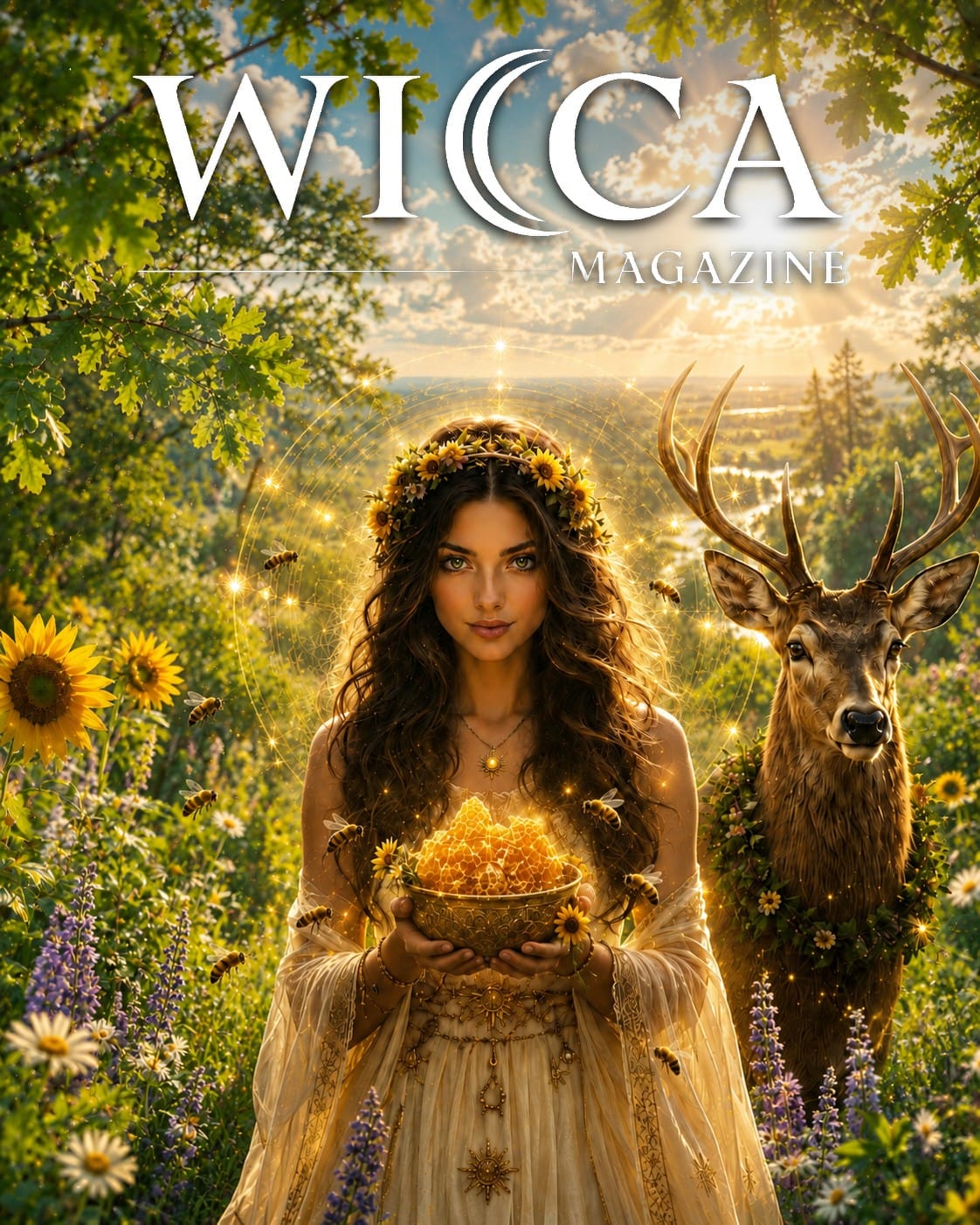
Unlock the Magick of Mabon! - Your Wicca Magazine Issue Awaits
Step into the season of light with Wicca Magazine. Each digital issue is a sacred offering of spells, rituals, and Wiccan wisdom — honoring ancient paths and empowering your modern magick. Your craft, your journey, your magickal sanctuary.
Some thirty years ago, I listened to Wiccan author Janet Farrar ask a diverse audience of American Wiccans and neo-pagans, "Who are the Goddess and God of America?"
This is a question we as 21st-century Wiccans and neo-pagan practitioners must ask ourselves. For many years after Janet's speech, this question has troubled me as a priestess. Most if not all the deities we modern Wiccans and neo-pagans honor are local gods and goddesses from someplace else in the world.
The Christian Community insists that America is a Christian country, but in the final analysis, even the god of Abraham is a local middle eastern desert deity. Yes, without a doubt, all or most of our neo-pagan deities are imported.
After Janet Farrar’s talk, her thoughts weighed heavily upon me. As an effort to honor some form of uniquely American vision of an American deity trinity, I established some token-icons on my altar. I had a small picture of James Dean as a god icon, Marilyn Monroe as a goddess icon and the Zuni two-souls We’Wha to be representative of a Native American primordial androgyne on my altar. But back in the day, even I didn’t adequately understand the Native American view of the spirits and the ancestrals.
The deep question is, who are the American Gods if any. This is something we as a greater American Wiccan and neo-pagan congregation, need to explore. I’m not suggesting that we form some new deity cult with a uniquely American flavor, good grief no. But I am suggesting that perhaps there is a new modern practice approach waiting to be evolved with inspirations from our massive American congregation and from knowledgeable advice from the Faith Keepers of the American indigenous peoples.
A word of thoughtfulness, before we make knee jerk leap and begin blindly adopting the land spirits that perhaps the Native Americans honored. I’ll suggest another approach later in this article.
Interestingly, numerous non-Christianized native Americans I’ve known over the years; never spoke or refer to resident gods or goddesses. As I came to understand it, their view of worship is completely different than our largely Western European and Middle-eastern approach of gods and goddesses. But in terms of finding a way to honor, respect, and perhaps venerate the indigenous spirits of North America, it’s important to have a little historical perspective on why this should be considered.
I wrote the following narrative back around 2010 while researching another project. I have never published it. What follows are two essay abstracts from the much bigger chronicle about the ramifications of the spiritual damage caused by the near annihilation of the North American indigenous peoples.
PROTECTED LAND – 2010 Abstract
I think the best place to start is during the American Civil War. During that conflict, there were reports by various Union units about being confronted by “peculiar events” during some of their field operations. For example, various companies attempting to attack confederate encampments in formerly Indian Territories and were confronted by “ghost warriors” for the lack of a better term. When such reports reached higher command. As a result, several very fine officers were relieved of their commands. About a dozen of these events were reported as the Union Forces pushed further and further into Southern states.
One of the most notable events occurred in northern Georgia when a Union company attempted to attack a Confederate unit on traditional Cherokee Tribal grounds. As the engagement began, the union soldier found themselves being attacked by an unseen force. As the battle ensured, the Confederates retreated, and the Union outfit was left to fend off a horrific battle with unseen warriors. One account from a Court Martial hearing investigating the event sums the situation like this.
A West Point graduate, army captain, was quoted as saying:
“we saw tomahawks raised in the air with no one holding them; we fired at the thin air near them to no effect. We all witnessed war hammers thrown at us by unseen specters. We saw bows and arrows drawn but by forces that were invisible to us.”
Responding to a question from a hearing officer, the frustrated young Captain (name redacted) replied: “You can’t shoot what you can’t see.”
The Union Army company mentioned above experienced 40% losses to an opposing “ghost” force that was intent on driving the Union company off former Cherokee land. In the years that followed the war, the native scouts reported the name of these “ghostly warriors,” the Nvnehi.
These accounts are available at the US Army War College archives in Carlisle, Maryland. Of course, all of these stories of ghost warriors were largely hushed up among polite church going Army officers, who were content to label the events either; out and out poppycock or if accepting that it happened in the first place assigning the event to the “the dreaded work of Satan.”
Except for an occasionally incredible battle yarn told by a drunken soldier near closing time at some isolated post’s bar, these events and accounts of them were largely forgotten.
FEEDING THE LAND – 2010 Abstract
I previously noted the Civil War to explain some of the bizarre events that occurred on the battlefield, especially when those aggressive actions were being executed on traditional tribal ground.
The Native Americans for generations have made regular offerings to the spirits of their ancestral tribal lands. When white man’s efforts to remove the Indians occurred, something was bound to give. For example, I can point to “The Trail of Tears."
The "Trail of Tears." is the name given to the forced relocation from Georgia, North Carolina, and Tennessee to Oklahoma of 17000 Cherokee in the years 1838–39. Some Cherokees escaped the Trail of Tears by hiding in the Appalachian hills or taking shelter with sympathetic white neighbors. The descendants of these people live scattered throughout the original Cherokee Indian homelands.
One eastern band Cherokee man explained to me a few years ago that with the native Cherokee largely absent from their traditional tribal lands, the spirits protectors of that land arose to protect those lands. It didn’t matter that it was Confederate soldiers that they were vicariously protecting; it was the land that was ancestral tribal land that was being protected.
Our white ancestors came here from Europe and from other places in total ignorance as to the temperament of the indigenous spirits of this new land. The Christian-Judeo tradition that our immigrant founders brought with them from Europe was arrogantly thought to surpass and counter all other spiritual beliefs. Needless to say, these Christian settlers and their clergy were ill-equipped to deal with these local spiritual forces, much less feed their needs.
A sermon and some hymns on Sunday were no match for daily high energy rituals and offerings of the native peoples that were performed day after day, year after year, generation after generation that fed the cosmic needs of the land. The resulting effect was that early settlers suffered on the land; suffered from crop failures, pestilence, and other troubles.
Several late 19th century mystics came to understand the cosmic ramifications of not feeding the land. Also, they decided to try and do something about it. They decided to discreetly perform ritual actions of a magickal nature to: “feed the great land of America and refill its Cosmic Cistern.” End-of-2010-Abstract
So, my Wiccan and neo-Pagan friends of the great American Pagan congregation. While we hold the Gods and Goddesses of many other cultures sacred in our hearts. I think it is important that we, as American pagans, begin having a going dialog about how we will attempt to recognize the ancestral spirits of this land that our ancestors immigrated to.
A respected high priest friend, and I discussed this over coffee recently, he remarked:
“We need to re-engage the spirits, the ancestrals, and the land. In a sense, we have already begun in various circles around the country with some traditional reclaiming rites. But this does not happen with a mere call to the spirits for gratitude. There is much more that needs and should be done. One of the ways is to bring the regional native people into our group circles and invite them to help us do this. The duty and responsibility are on us to embrace a new form of spiritual diversity within our practices.”
A word of restraint, before every witch and witchlet reading this article, starts calling their local tribal office or cultural center. I suggest restraint and that this topic is seriously discussed with local Wiccan and Neo-pagan elders first.
After some consensus, perhaps few learned Wiccan and Neo-pagan elders could reach out as a delegation, quietly and respectfully make these contacts. In some cases, there are probably a few folks in your community already who have friends and contacts with local tribal communities. But approach them very respectfully, they have plenty of reasons not to trust us. Bright Blessings!
Exploring the mystical path of Wicca with every turn of the page. Join us in celebrating the wheel of the year.
Support@WiccaMagazine.com
Newsletter
Unlock the Secrets of the Craft: Subscribe now to receive exclusive content, seasonal rituals, and magickal insights directly to your inbox.
© 2025 Wicca Magazine - All rights reserved.


Unlock the Secrets of the Craft:
Subscribe now to receive exclusive content, seasonal rituals, and magickal insights directly to your inbox.
© 2025 Wicca Magazine - All rights reserved.